Modern vehicles are computer networks on wheels. Cameras, sensors, control units and driver assistance systems continuously exchange large amounts of data. As digitalization advances towards autonomous driving, the demands on data transmission continue to increase. Conventional vehicle buses are increasingly reaching their limits, particularly in data-intensive applications.
Automotive Ethernet – the beginnings
The automotive industry therefore began looking for a networking technology that could deliver high data rates while requiring little space and remaining cost-effective to integrate. One of the first solutions was BroadR-Reach, a predecessor of today's Automotive Ethernet standards.
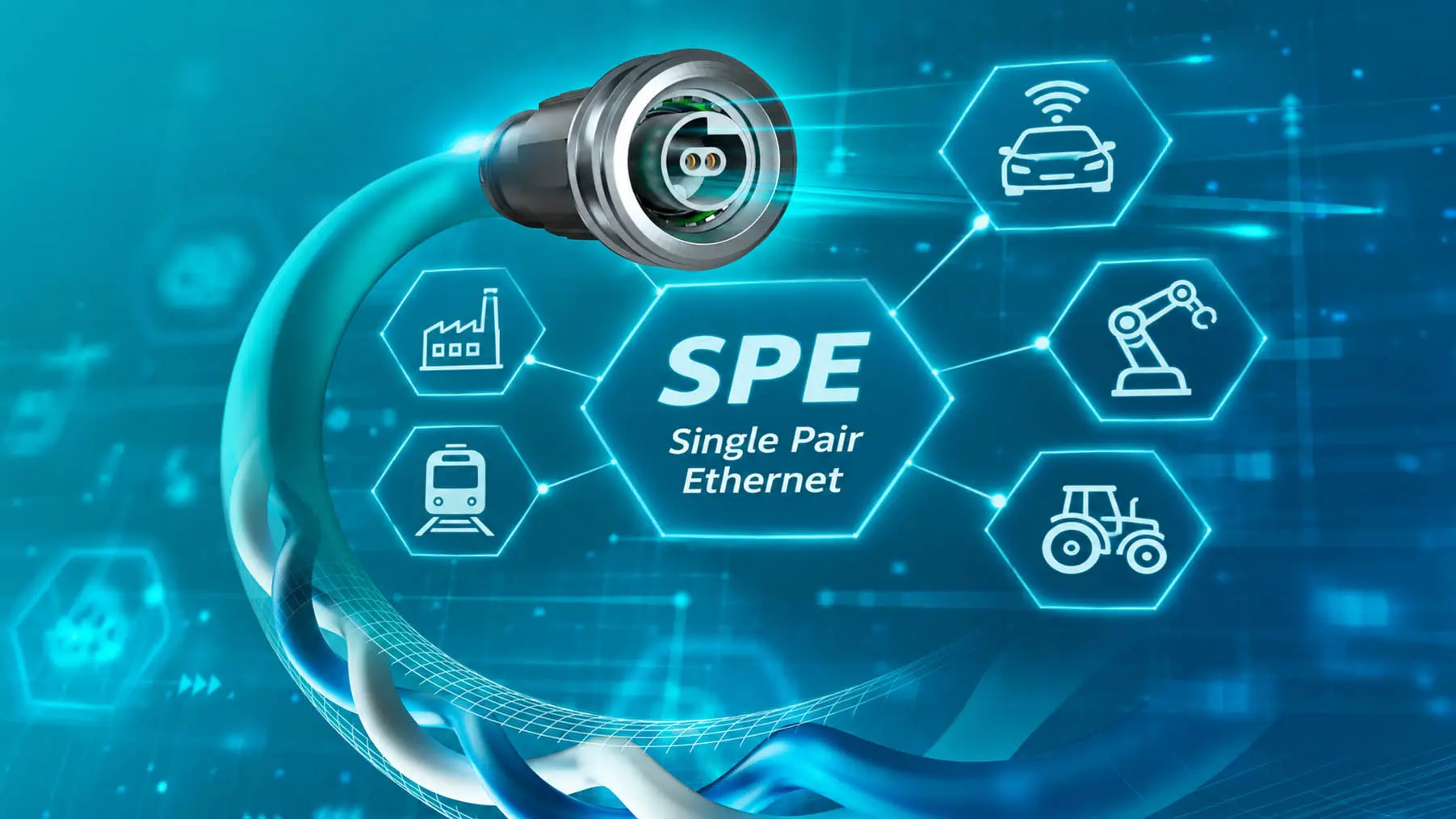
The technology is based on Ethernet but requires only a single twisted pair of wires for data transmission. Hence the name Single Pair Ethernet (SPE). Today, SPE is also gaining importance in industrial automation, robotics, mobile machinery and railway applications. All these sectors require compact, robust and reliable networking solutions.
What distinguishes SPE from conventional Ethernet?
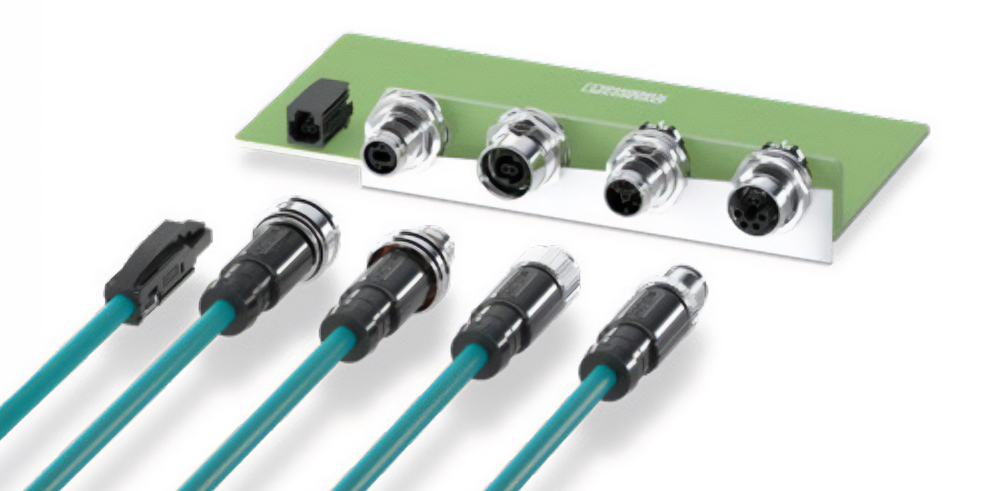
The most obvious difference is the cabling. While conventional Ethernet requires two pairs of wires for 100 Mbit/s and four pairs for 1 Gbit/s, SPE needs only one. This reduces weight, space requirements and material consumption.
Another advantage is that SPE builds on established Ethernet technology. Developers can therefore draw on an extensive ecosystem of network protocols, software libraries and development tools. This makes integration into existing IT and OT infrastructures easier.
Different standards for different requirements
SPE comprises several variants defined within the IEEE 802.3 family of standards. They differ in terms of data rate, transmission distance and network topology.
10BASE-T1S
10 Mbit/s, up to 15 m in multidrop operation or 25 m for point-to-point connections. Multiple devices can share a common cable.
10BASE-T1L
10 Mbit/s over distances of up to 1,000 m. Particularly suitable for process automation.
100BASE-T1
100 Mbit/s over typically 15 m. Used, for example, for sensors and control units.
1000BASE-T1
1 Gbit/s over typically 15 to 40 m, depending on the channel type. Designed for data-intensive applications.
2.5/5/10GBASE-T1
2.5 to 10 Gbit/s. The transmission distance depends on the variant and cabling.
The 10BASE-T1S and 10BASE-T1L variants are particularly interesting. While T1L supports long transmission distances, T1S enables so-called multidrop topologies. Multiple devices share a common cable, eliminating the need for a separate point-to-point connection for each device.
Less cabling, fewer interfaces
In addition to compact cabling, SPE offers several other advantages.
- Ethernet down to the sensor level: SPE enables end-to-end Ethernet communication down to individual sensors. This makes it easier to integrate different devices into common networks.
- Lower resource consumption: Thinner cables and compact connectors save weight, copper and plastics. This can also reduce cabling costs.
- Power over the data line: Power over Data Line (PoDL) allows compatible sensors to receive both data and electrical power through the same pair of wires. Separate power cables are no longer required.
- Precise time synchronization: SPE can use Ethernet mechanisms such as the Precision Time Protocol (PTP). Combined with Time-Sensitive Networking (TSN), time-critical applications can be implemented with suitable hardware.
However, SPE is not inherently faster or more cost-effective than conventional Ethernet. The decisive factors are the selected variant and the requirements of the application.